If you’ve been struggling with a nagging injury, like an Achilles tendon that won’t heal or a frozen shoulder that limits your movement, you’ve likely heard the term “shockwave therapy” thrown around. It sounds intense, perhaps even futuristic, but it’s rapidly becoming a gold-standard treatment for chronic pain and soft tissue injuries.
But what exactly is it? And more importantly, can it help you get back to the activities you love?
In this guide, we break down exactly what focused Extracorporeal Shock Wave Therapy (f-ESWT) is, the science behind how it works, and why we use it at M20 Health and Performance to help our clients recover faster.
What is Focused Extracorporeal Shock Wave Therapy (f-ESWT)?
Despite the name, there are no electrical shocks involved. Focused ESWT is a non-invasive treatment that uses high-pressure acoustic sound waves to target injured tissue deep within the body.
Originally developed in the 1980s to break down kidney stones without surgery, the technology was adapted for musculoskeletal use when doctors noticed it also promoted tissue healing.
Unlike radial shockwave therapy, which disperses energy over a wide area like a shotgun, focused shockwave therapy allows us to direct concentrated energy into a specific point at a specific depth—think of it as a sniper approach. This precision allows us to treat deeper tissues without losing energy at the skin’s surface, making it highly effective for stubborn injuries near the bone.
How does Shockwave Therapy work?
The mechanism behind f-ESWT is fascinating. It works by creating “micro-trauma” to the area, which sounds counterintuitive, but is actually the key to restarting your body’s stalled healing process.
When the acoustic waves hit the damaged tissue, they produce two main effects:
1. Mechanical Stimulation
The waves create rapid vibrations and micro-cavitation bubbles. This mechanical stress breaks down scar tissue and calcifications (calcium deposits) that often form in chronic tendon injuries. By “loosening” this unhealthy tissue, we pave the way for healthy fibers to grow.
2. Biological Response (The Healing Cascade)
This is where the magic happens. The physical stimulus triggers a biological response known as mechanotransduction. This process:
- Increases blood flow: It stimulates neovascularisation (the formation of new blood vessels), bringing oxygen and nutrients to the injury site.
- Stimulates collagen production: Collagen is the building block of tendons and ligaments; producing more helps repair the structure.
- Reduces pain: The shockwaves can inhibit pain receptors and dampen the transmission of pain signals (a process called "overstimulation analgesia"), providing relief that can be immediate.
What conditions can it treat?
Focused shockwave therapy is particularly effective for “chronic” conditions—injuries that have lingered for more than 6 months and haven’t responded well to standard rest or ice.
At M20 Health and Performance, we commonly use f-ESWT to treat:
- Plantar Fasciitis: Chronic heel pain and thickened fascia tissue.
- Achilles Tendinopathy: Pain and stiffness in the heel cord.
- Tennis & Golfer’s Elbow: Lateral and medial epicondylitis.
- Patellar Tendinopathy: Often known as "Jumper's Knee".
- Calcific Tendonitis: Calcium deposits in the shoulder rotator cuff.
- Greater Trochanteric Pain Syndrome: Pain on the outside of the hip.
- Bone Stress Injuries: Including stress fractures and non-unions (bones that fail to heal).
What to expect during a treatment session
If you book a session at M20 Health and Performance, here is typically what happens:
- Assessment: We always start with a clinical examination. We may use ultrasound or review MRI imaging to confirm the lesion and ensure shockwave is the right tool for you.
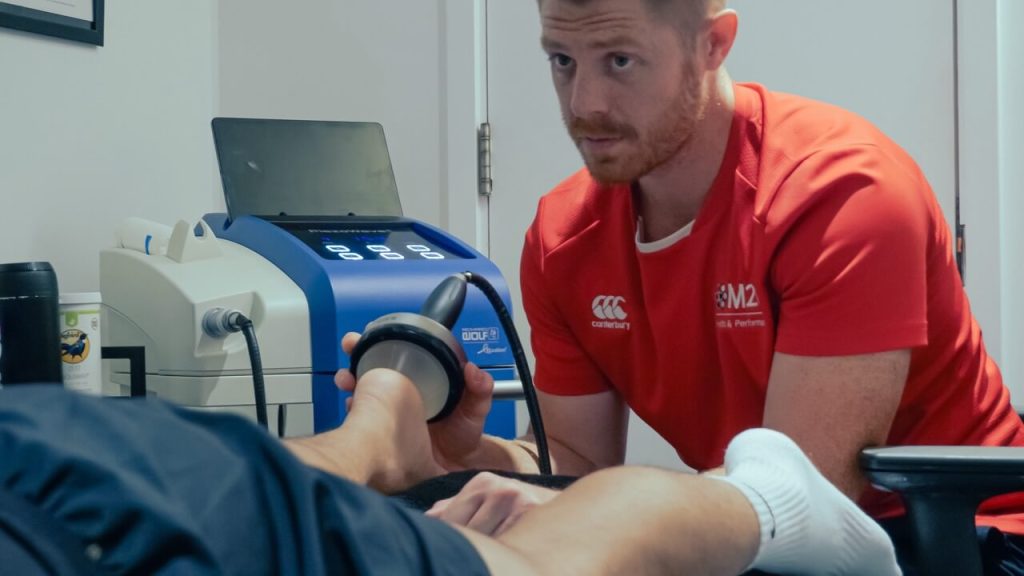
- The Setup: You will sit or lie comfortably. We apply a coupling gel to the skin, which helps the sound waves travel efficiently into the body.
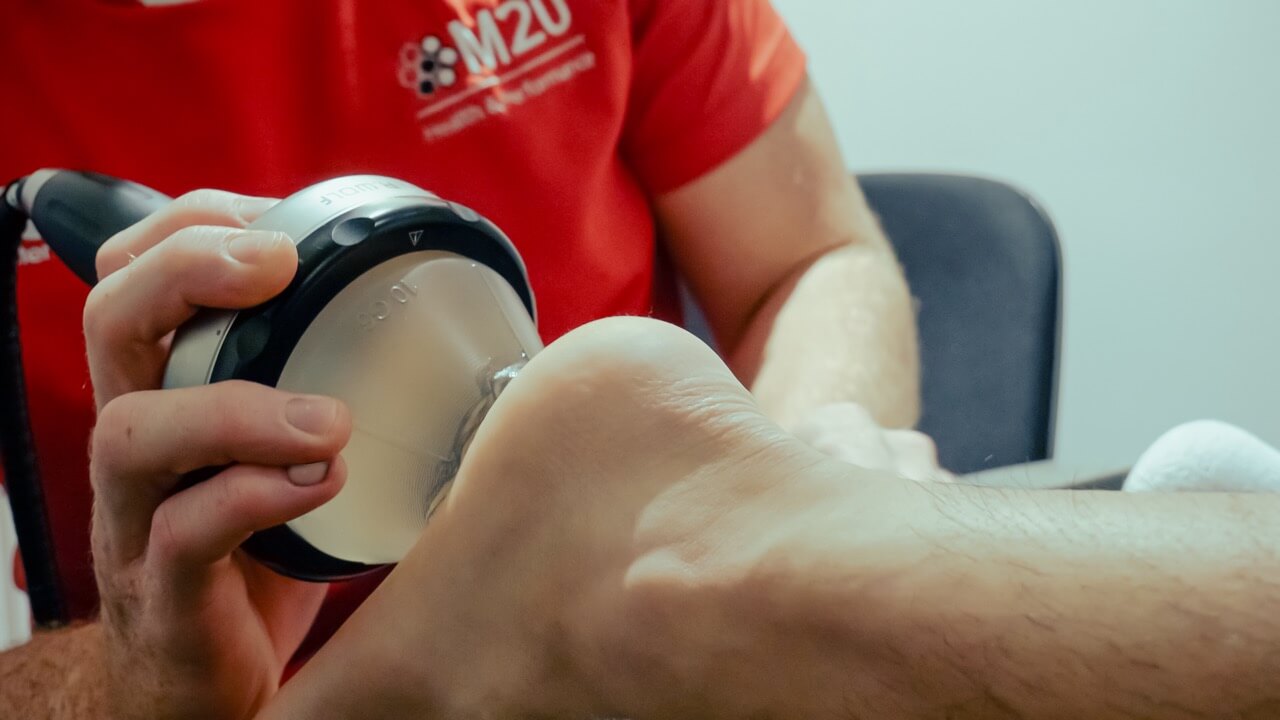
- The Treatment: Your therapist will position the handheld applicator over the injury. We gradually increase the intensity until it reaches a therapeutic level. You will hear a clicking sound and feel a dull, pulsing sensation.
- Duration: The actual delivery of the shockwaves typically takes about 10–15 minutes per injury site.
Does it hurt?
Most patients describe the sensation as “uncomfortable” rather than outright painful. We aim for a sensation level of about 5/10. It needs to be strong enough to trigger a response, but we can adjust the power to ensure it remains tolerable for you.
Why we combine Shockwave with exercise
While shockwave therapy is a powerful tool, it isn’t a magic wand. We view f-ESWT as a “kick-starter” for healing.
To get long-term results, the newly forming tissue needs to be strengthened. That is why at M20 Health and Performance, we almost always combine shockwave therapy with a tailored rehabilitation program.
Research suggests that combining f-ESWT with eccentric loading (specific strength exercises) outperforms either treatment alone. The shockwave reduces the pain, allowing you to perform the exercises that build the long-term resilience of the tendon or muscle.
Is Shockwave Therapy safe?
Yes, f-ESWT is widely regarded as safe. Serious complications are extremely rare. The most common side effects are minor and short-lived, including:
- Temporary soreness
- Mild swelling
- Redness or bruising at the treatment site
These typically resolve within a few days. We usually advise patients to avoid vigorous impact activity for 48 hours after a session to let the tissue settle.
Important Note: We generally avoid using shockwave therapy if you are pregnant, have a blood-clotting disorder, have a pacemaker, or have an infection or tumour at the treatment site.
Ready to restart your recovery?
If you have been dealing with a tendon injury that just won’t go away, focused shockwave therapy could be the breakthrough you need. It’s non-invasive, efficient, and backed by clinical evidence.
Don’t let chronic pain dictate your lifestyle. Get in touch with the team at M20 Health and Performance today to discuss whether f-ESWT is right for you.