If you have been struggling with a stubborn injury, such as Achilles pain, plantar fasciitis, tennis elbow, or a shoulder problem that keeps coming back, you may have heard of shockwave therapy.
Despite the name, there are no electrical shocks involved. Focused Extracorporeal Shock Wave Therapy, often shortened to focused shockwave therapy or f-ESWT, uses targeted acoustic sound waves to stimulate irritated or slow-healing tissue.
At M20 Health and Performance in Manchester, we use focused shockwave therapy to support recovery from chronic tendon pain, soft tissue injuries, and selected bone stress injuries. It is not a magic wand, but when combined with a proper assessment and tailored rehabilitation, it can be a powerful tool for getting recovery moving again.
Focused shockwave therapy is a non-invasive treatment that delivers mechanical sound waves through the skin into a specific area of injured tissue. The goal is to stimulate a healing response in tissue that has become painful, overloaded, or slow to recover.
It is commonly used for longer-lasting tendon and soft tissue problems, especially when symptoms have not improved with rest, stretching, massage, or general exercise alone.
Focused shockwave is different from radial shockwave. Radial shockwave spreads energy more broadly across surface tissues, while focused shockwave allows the clinician to target a more precise point and depth. This can be especially useful for deeper or more localised problems, such as tendon pain near the bone or calcific tendon issues.
Focused shockwave therapy works by creating a controlled mechanical stimulus in the injured area. This can help trigger a biological response in the tissue, encouraging repair and helping to reduce pain.
The treatment may help by:
In chronic tendon injuries, pain is often not caused by simple inflammation. The tendon may have become irritated, thickened, sensitive, and less able to tolerate load. That is why rest alone often does not solve the problem.
Shockwave therapy can help calm symptoms and stimulate recovery, but the tissue still needs to be strengthened properly. This is where rehabilitation becomes essential.
At M20 Health and Performance, we commonly use focused shockwave therapy for:
The evidence varies depending on the condition. Research support is particularly strong for plantar fasciitis, while results for Achilles and patellar tendinopathy can be more mixed. That is why proper diagnosis and patient selection matter.
Your first session starts with an assessment. We look at your symptoms, movement, strength, training history, and the likely source of the problem. Where appropriate, we may use ultrasound assessment or review previous imaging to help guide treatment.
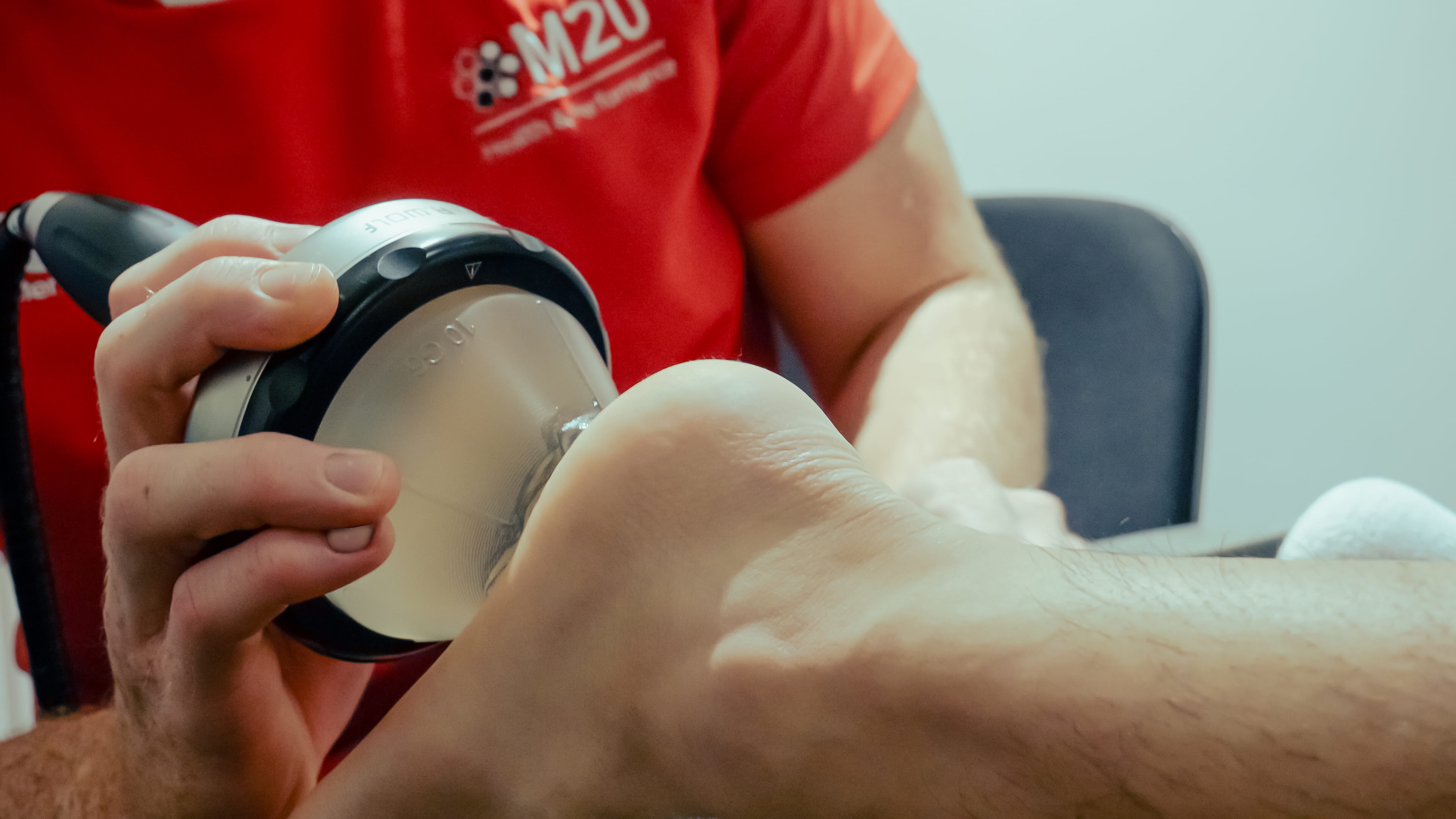
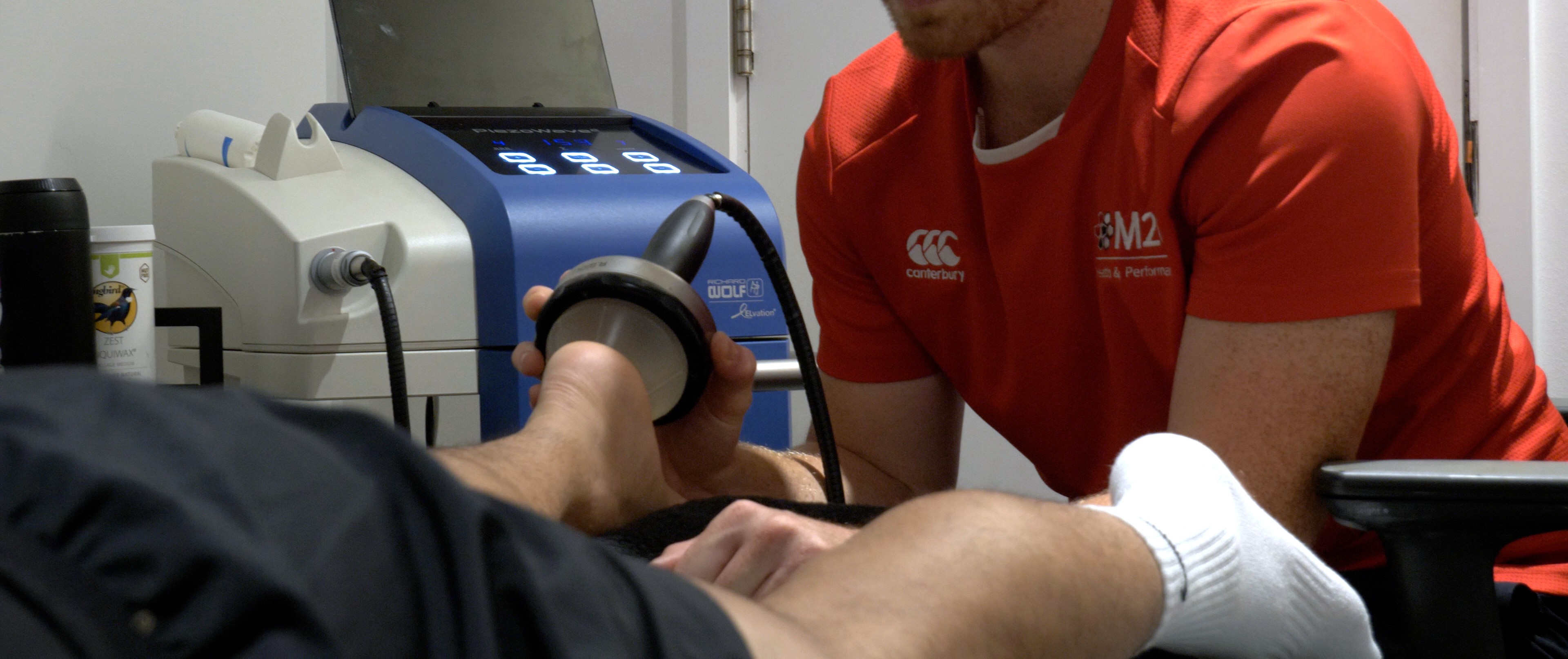
During treatment, gel is applied to the skin and the shockwave applicator is placed over the target area. You will hear a clicking sound and feel a repeated pulsing sensation. The intensity is adjusted to a strong but tolerable level.
Most people describe shockwave therapy as uncomfortable rather than painful. Some soreness, redness, swelling, or bruising can happen afterwards, but this is usually short-lived.
The shockwave part of the session usually takes around 10–15 minutes per area, although the full appointment includes assessment, explanation, treatment, and rehab advice.
This depends on the injury, how long it has been present, and how irritable the tissue is. Many patients have a short course of around 3 sessions, often spaced 1–2 weeks apart.
Some complex or long-standing cases may need a different plan. Your clinician will explain what is realistic after assessing you.
Focused shockwave therapy can help reduce pain and stimulate tissue repair, but long-term improvement depends on building the tissue’s capacity again.
For tendon injuries, this usually means progressive loading. That may include isometric exercises, eccentric work, heavy slow resistance training, plyometrics, running changes, or sport-specific strengthening.
At M20 Health and Performance, we rarely view shockwave as a standalone treatment. We use it as part of a wider recovery plan designed to help you move better, get stronger, and return to the activities you care about.
Focused shockwave therapy is widely regarded as low risk when delivered by a trained clinician after proper assessment. However, it is not suitable for everyone.
We may avoid shockwave therapy if you are pregnant, have a blood-clotting disorder, take certain blood-thinning medication, have an infection or tumour in the treatment area, have a pacemaker, recently had a steroid injection, or have a recent tendon or ligament rupture.
This is why every treatment starts with a clinical assessment.
If you have been dealing with persistent tendon pain, plantar fasciitis, Achilles pain, tennis elbow, shoulder pain, or another stubborn soft tissue injury, focused shockwave therapy may be worth considering.
Based in West Didsbury, Manchester, M20 Health and Performance supports patients from across South Manchester, Didsbury, Chorlton, Sale, Stockport, Altrincham, Cheshire, and the wider North West.
Book an appointment with our team to find out whether focused shockwave therapy is the right option for your recovery.